Showing posts with label Culinary Adventures. Show all posts

Wednesday, February 5, 2014

It's a Bird, It's a Plane, It's Epicure Imports!

In a most unassuming industrial location deep in the San Fernando Valley, resides a gourmet treasure hunt.   Directly under the glide path into Burbank's Bob Hope airport, Epicure Imports distributes high-end gourmet items to restaurants, hotels, caterers, chefs, resorts and retail.  Their daily deliveries can include stops San Diego, Palm Springs, Orange County, LA as well as San Francisco and Las Vegas. 

Fortunately, I caught a random blurb on my neighborhood Patch back in December announcing an Open Warehouse sale at this import place I had never heard of.  Intrigued, John and I viewed this as a culinary field trip where we may or may not buy anything.

Owner Preparing to Open the Doors
A Small Portion of the Line Waiting to Get In
When Epicure Imports has their Open Warehouse sales for the general public (next one is this coming weekend), it's usually discovered by word of mouth.  By the looks of the line to get in before the doors opened, it appears Los Angelenos can't keep this a secret.  We went on the second day of their December sale, a Saturday at 9a (the moment they opened their doors) and the line strung through the parking lot out to the street.

Talk about a kid in a candy shop, any foodie will go bonkers in here.  Those impossibly creative restaurant specials more than likely started with sourcing an ingredient from a place just like this.  No wonder high-end restaurants appear to be superheroes.  Here is just a minor sampling of the goodies we found during our winter excursion:


Here's what you need to know before going.  Bring a jacket; you'll want to spend plenty of time in their refrigerated rooms where mountains of cheeses, butters and meats are stored.  Also bring your own bags.  They do accept debit, credit cards and cash. 


One more thing to anticipate; the sale is popular and wait time to checkout may take a bit.  Be patient...it's worth it. 


Their schedule for the Open Warehouse events is below.  If you still are unsure and need further enticement, click **here** for their February product list.  Happy hunting!


Friday, August 23, 2013

A Story of One City Farm

Even Cabrini-Green isn't immune to the idea of transformation.  The most notorious public housing of my generation began demolition over 13 years ago.  A small portion of it has now evolved into an urban farm.


1204 N. Clybourn as of August 2013


Courtesy Chicago Sun-Times, prior to demolition in the late 90's

Courtesy The Rap Dictionary http://www.rapdict.org/Cabrini-Green

At one point over 15,000 people called this area home.  High rises, low rises and row houses meant to corral like low-income citizens, turned into a place where Thelma Ruffin, a Cabrini-Green resident who ran a Local Advisory Council said, "You see kids running around the buildings all the time, but they don`t have anywhere to go because they don`t have any programs for them."  The confluence of little to no government funding for police or programs and its proximity to very affluent neighbors a couple blocks over made the area a lucrative area for drug sales.  Intense competition ensued turning the housing project into a war zone of drugs and violence.

Imagine, the only place you know is more comfortable than the one that you don't know.  Cabrini-green residents were relocated to mixed-income neighborhoods throughout the city; scattered to the wind like seeds intended by housing officials to find their way to a grow a new generation in "better" circumstances.  Depending on who you ask, that has been debatable.

 
On a lot near where people once threw trash into part of a complex adjacent to the Chicago Board of Education`s Ferguson Child-Parent Center on 1215 N. Clybourn Ave.,  I now marvel at it's beauty and its' productiveness thanks to Chicago Lights Urban Farm.


Never forgetting so many were displaced from their homes, regardless of the conditions, the farm was created to give way to new economic opportunities.   Through nutritional education and work-force training, it now provides a safe haven for children to learn about urban farming. Where competition for turf once resulted in gang wars, now the competition is about getting a slot to participate in the work-force training program.


Not to be minimized, the farm provides access to healthy food in a place that has been known to be a food desert.  The farm participates in CSA's, farmer's markets and sources local restaurants.  According to a recent article in the Chicago Sun-Times, 253,000 pounds of fruits and vegetables have been grown this year on 15 acres of urban farms in the city of Chicago alone.


Packing up for Farmer's Market

While I am a visitor today, I know this Urban Farm too shall transform yet again.  You see, I once lived not to far from here.  Chicago does not standstill. 

In February, 2013, the Fourth Presbyterian Church behind the Chicago Light project sought help to fund the property.  With no such suitor to be found, the board accepted an offer from the Chicago Housing Authority to buy the property with a lease-back option for free.  What we do know, is they will continue operating until May 2015 until which time they may need to find an alternate site to continue their mission.  It is unknown, at the time of this writing, the future plans the Chicago Housing Authority has for the property.

My thanks to the volunteers at the farm who allowed me to take pictures in their fields on this fine August day.


Sunday, April 28, 2013

It's Not All About Voodoo Donuts

There's more to the Portland food scene than what you've witnessed on TV.   Then again, can't that be said about anything being misunderstood, even if it's just a bit?  If you are slightly epicurious, then the Epicurean Excursion from the Portland Walking Tours is for you.  (No they didn't pay me...I paid them!)

First mission, knock out all the Portlandia episodes I just marathoned before our trip from my memory.  Portland couldn't possibly be THAT into birds, cacao, green-anything and coffee.  Or could they?


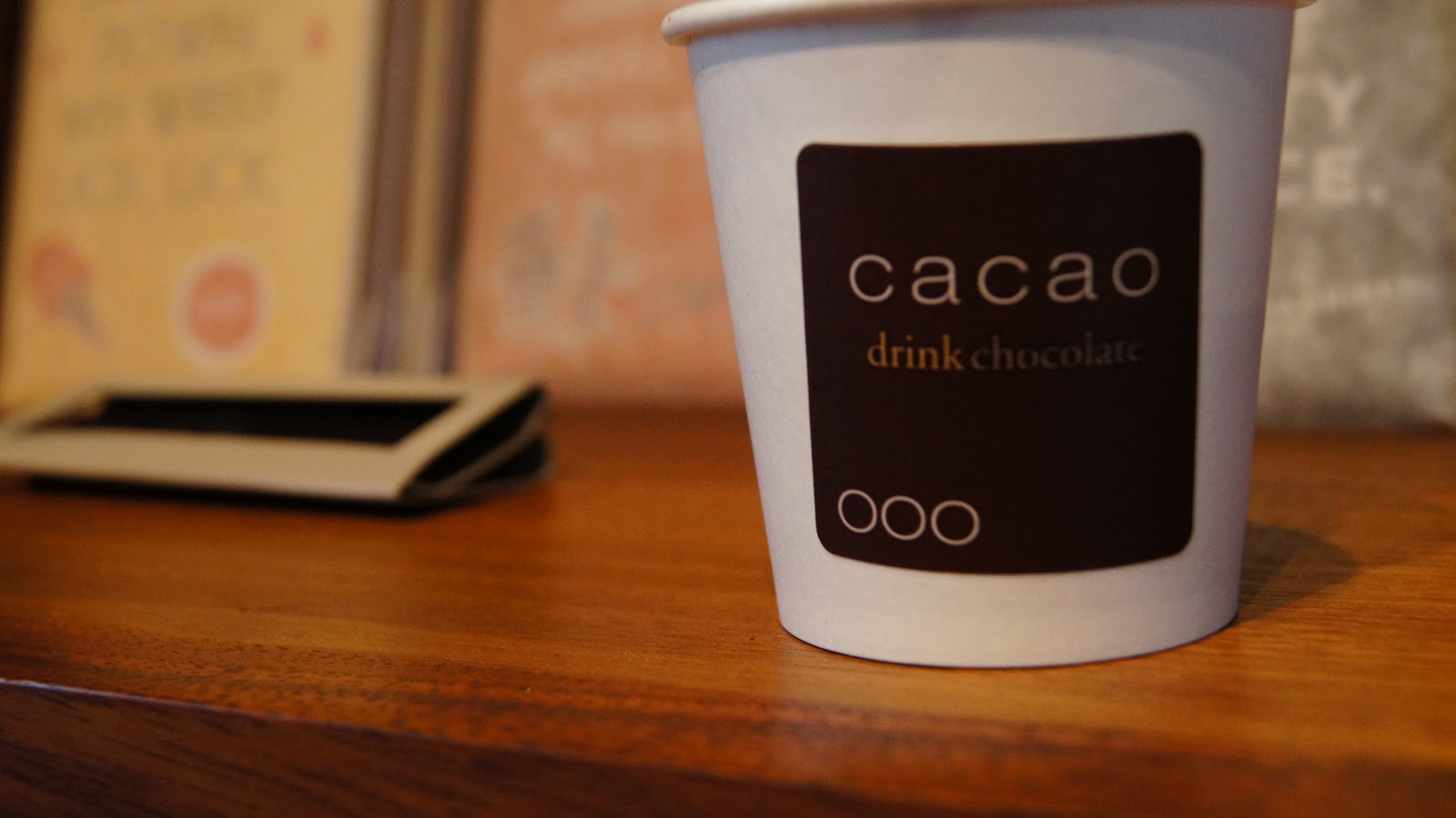
First stop, Cacao Drink Chocolate.  Okay, so much for the safe word exiting my brain. The cup of hot chocolate below is the most silky, rich beverage I've ever had.  And not too sweet at all.  What makes it so?  The store sources their chocolate bars from small producers with the criteria you would imagine (fair trade, organic, limited chains of manufacturing and minimizing fillers such as wax).  The owner celebrates his curation so much so, he showcases the farmer on the labels.


If I learned anything on this excursion, all valuable edibles have a fan base resembling the qualities of a wine aficionado.  Onto the Flying Elephants Deli.


Everything made out of this deli is done with care of using in-season ingredients including their infamous tomato/orange soup.  Amazingly good, we went back here later in our trip for a full lunch.


The savory soup, so popular with locals they begged for the recipe.  And the deli has shared it.  Click here if you're interested.  Smartly, the deli knows it is VERY difficult to successfully use citrus with a creamy base without curdling.  Good luck to you!

No food tour in Portland would be worth its efforts without a stop at one of the infamous food carts permanently parked in a pay parking lot.


The owners of these parking lots reap huge financial rewards by bordering their lots with these food trucks who pay for "parking" as any other vehicle would, but 24/7.  For the vendor, this is a way to have a food business without the huge outlay for a brick and mortar restaurant.  Everyone views this as a win/win.   Because our tour was in the morning, our stop was for liege waffles.


Super indulgent waffles are made with a brioche dough (not batter) and pearl sugar.  Crazy sweet and extravagant.  I'm now deeply wanting a cup of coffee.  Our intuitive guide was on it.  Courier Coffee Roasters to the rescue.


While Stumptown Roasters is the most known, there are roasters on seemingly every corner of Portland.  What makes Courier special is they can only be had if it's within biking distance of the roasting facility.  I'm not exaggerating.  A typical delivery bike just above services many local restaurants.  Not only does their business model exemplify hyper local, but they aim to be incredibly sustainable.  The packaging of their coffee made entirely of compostable paper and they are working on a system of "milk on tap" to circumvent the constant opening of the refrigerator at their coffee bar.

What better way to soak up all that caffeine than a behind the scenes stop at Pearl Bakery.


Another very local approach, using as many organic ingredients as possible they source their flour from millers in eastern Washington and serve McMinnville's locally churned butter.  Bread-aholic or not, it would have been rude not to consume their tasting platter don't you think?

Thank goodness our next stop didn't require eating!


 The Camellia Lounge is a charming tea house where you can sample teas from around the world.  Come the weekends it transforms into a live jazz venue.  Most seductive and never knew existed we learned about tea bricks.


Used primarily in the 19th century, fermented tea was pressed into forms to make better transport of the ingredient.  Today, they are mostly sold as a novelty.

Apparently we still looked hungry and were escorted over to Hot Lips Pizza.  Family owned and hyper-local, the gourmet pizzas are made with ingredients only in season.


It doesn't seem possible, but we had a dessert stop.  Cool Moon Ice Cream makes home-made, hand-churned ice cream made with Oregonian ingredients.  My choice, blackberry ice cream.


Because we could put no more down our gullet, our last stop was Benessere's Oils and Vinegars.  The least "local" stop, was still an informing touch on an ever-increasing focus on quality olive oils and vinegars.


The only missing highlights (in my opinion) would be a local brew stop at Deschutes Brewery and the new/used cookbook aisles (there are 3-4 long aisles) at Powell's Books.   Happy adventuring!


Monday, December 31, 2012

Foodscaping in LA

A day filled with food, architecture, design and art make for a complete and soul satisfying day for me.  Had I had any idea all of this could be accomplished in L.A, I would have sought it our earlier.  I had no idea there was neighborhood gentrification going on just east of downtown L.A.  I had no idea my city had developed an Arts District in that neighborhood.  I had no idea this gentrified warehouse district, now known as the Arts District is the home of many new and old food based businesses. 

Biscuit Company Lofts, formerly The National Biscuit Company West Coast Headquarters
Then again, when you live in Los Angeles, one tends to stick within their 5 mile radius to avoid traffic. What a shame.

Burning off the last couple of vacation days of 2012, John and I opted for a staycation.  What to do so it feels like we actually took a vacation?  We took a chance on a random email invite from the Foodprint Project to take a foodscape mapping walk of downtown LA's new and old food related businesses.  What is the Foodprint Project you ask? 
Foodprint Project is an exploration of the ways food and cities give shape to one another. Founded by Nicola Twilley and Sarah Rich, the project is punctuated by a series of events in physical space.  Foodprintproject.com
We've done walking tours of other cities.  Why not do one our own town?   Even more intriguing, we could participate in mapping what we're seeing in real time with our cell phones.  How hipsterish!


This BID (Building Improvement District), aka Warehouse/Arts District has really been in transition for  decades.  What started out as citrus groves in the late 1800's, turning into rail yards for centralized warehouse goods distribution to abandoned old-school industrial spaces is now a burgeoning, thriving hub of artistic green living.

Old Rail Spur Turned to Strolling and Dining Charm
The zoning, existing building stock and the neighborhood had the right combination to encourage this urban center to become home to artists' live/work studios.


Food artisans naturally are attracted to the same environs creating a new wave of creative food-based businesses.

Remember our food mapping project?  Over 50 people participated on the walk.  For those who wanted to participate, we live texted pictures to a central website of what we were seeing along the way.  At the end of our journey we would be able to see our collective pictures documenting our experience.

Let's get started.  Our first stop, a caffeine artisan.  Handsome Coffee Roasters goals include being hospitable, accessible and giving uncompromising quality. Roasted on site, co-owner Tyler Wells graciously opened up their workroom to show off their antique beauty of a roaster to us. 


A coffee tidbit according to Tyler, you shouldn't have to doctor up coffee (i.e. sugar, cream, etc) to make it taste palatable. A good cup of coffee means the roasted beans haven't been burnt. You know who he's talking about if you've been to any top visited coffee chain.

Along the way to our next destination, the friendly neighborhood greeter...


A work in progress, the couple behind The Spirit Guild describe their vision of making craft liquor from California's own abundant source of sugar, fruit.  Standing in front of their newly acquired workspace, their description neatly fits the definition of the farm to table movement.  Their distillery is slated to open in 2013.  Yes, they will have a tasting room, pending permitting of course.

Site of the Future Spirit Guild

As in any gentrifying urban neighborhood can attest to,  groceries can be hard to come by.  Even though the district's residential population is growing leaps and bounds, there is no grocery store; a food desert.  For now, most residents are making weekly treks to Pasadena 12 miles away.  That will soon change.
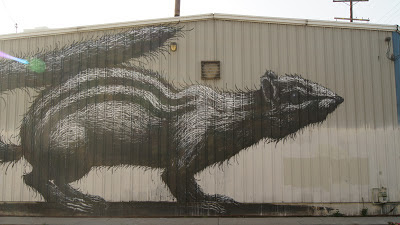
Mural by Street Artist, Peter Roa

Local Arts District residents Keri Aivazis and Carolyn Paxton have made the steep investment of retrofitting the old warehouse above into a future food market.  The ginormous chipmunk mural painted as a Los Angeles Freewalls Project will be retained.   It will be known as the Urban Radish where most items will be locally sourced and finely curated.  Knowing their typical consumer, it will have a full range of pricing and small packaging for living in a small urban kitchen.


A Sneak Peek at the Plans

Metal Shed to Retrofitted Building Housing a Grocery Store
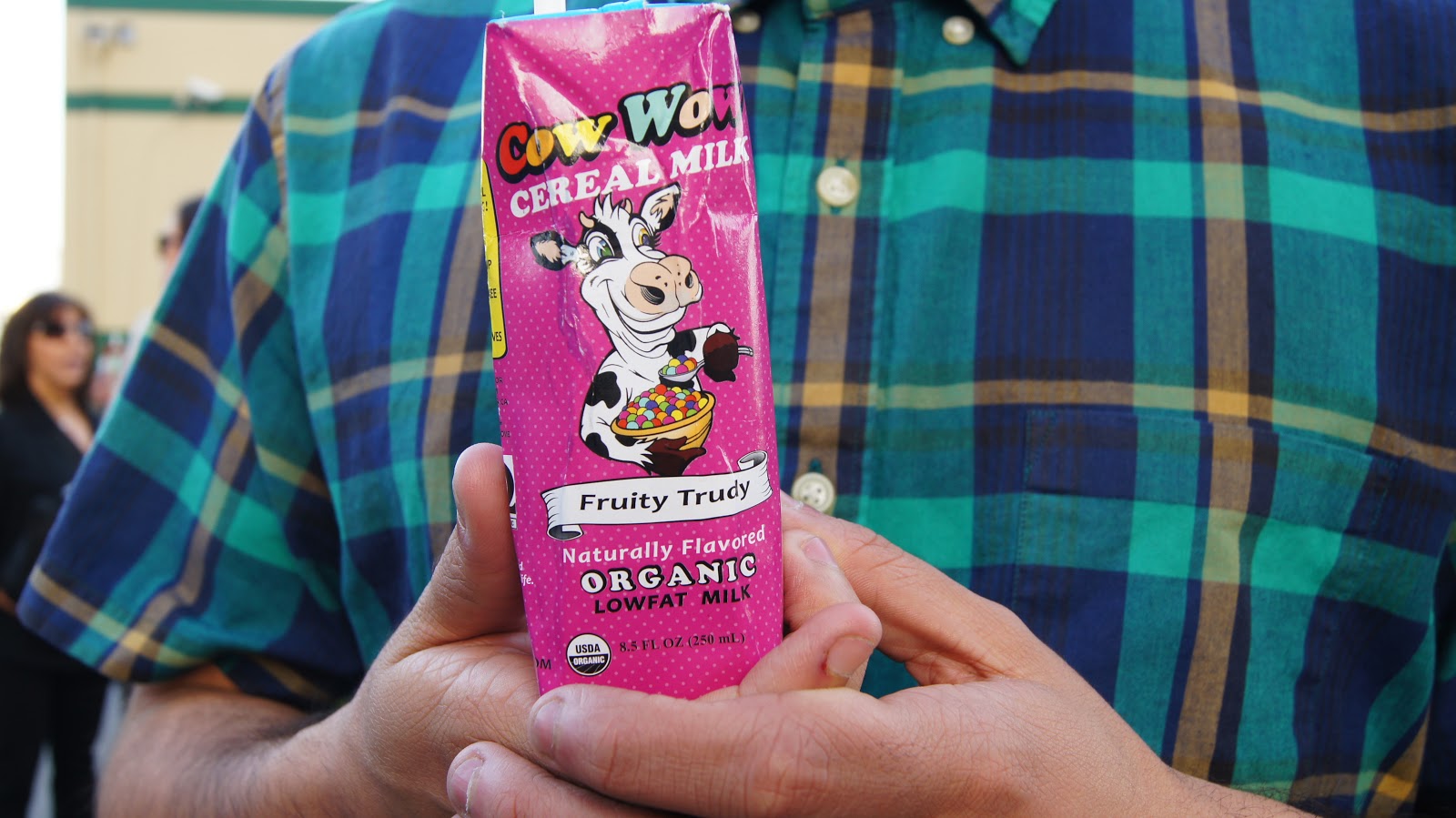
Not all food artisans are requiring a store front.  Instead of eating Fruit Loops, why not have your healthy cereal accompanied by Cow Wow organic milk tasting like Fruit Loops.  Best way to get the word out at the moment, be a street vendor.


Our food culture requires mass food warehousing before final distribution.  Imagine trying to feed over 12 million people in the LA metro area and beyond.  We visited one such cold storage business.


Up & Coming Chefs Ask this Warehouse for the Next Hot Item, Edible Herb Crystals

The end of our tour led us to the latest entree to the District, Beastia.  Less than 2 months old, head chef Ori Menashe makes everything from scratch including curing his own meats.  If only I could share with you the tremendous smells emanating from this restaurant. 


After our adventurous walk we ended at Villain's Tavern for happy hour, where we viewed (and you can too) our collective mapping activity led by civic media and gaming researcher, Benjamin Stokes.  Seeing what we had just witnessed through other people's lenses made the journey all the more interesting.

Once again life proves taking a chance on doing something out of the ordinary can deliver its greatest rewards.  That very statement has given me a moment of clarity and an idea about the future of this blog.   Stay tuned .....

Happy New Year!
Related Posts Plugin for WordPress, Blogger...
Powered By Blogger